

Agena offers various flow control facilities such as:
- if/then/elif/else conditions,
- case of/else conditions similar to C's switch/case statements,
- is operator to return alternative values,
- numerical for/from/to/by loops where start, stop, and step values are optional, and automatic round-off error correction of iteration variables,
- combined numerical for/while loops,
- for/in loops over strings and complex data structures,
- while and do/as loops similar to Modula's while and repeat/until not() iterators,
- a skip statement to prematurely trigger the next iteration of a loop,
- a break statement to prematurely leave a loop,
- data type validation with the try/else statement and the optional double colon facility in parameter lists.
Data types provided are:
- rational and complex numbers, with extensions such as infinity and undefined,
- strings,
- Booleans such as true, false, and fail,
- the null value meaning 'nothing',
- multi-purpose tables implemented as associative arrays to hold any kind of data, taken from Lua,
- Cantor sets as collections of unique items,
- sequences, i.e. vectors, to internally store items in strict sequential order,
- pairs to hold two values or pass arguments in any order to procedures,
- user-defined types for sequences, tables, and pairs to allow for special-purpose handling,
- threads, userdata, and light user data inherited from Lua.
Procedures with full lexical scoping are supported, as well, and provide the following extensions:
- the << (args) -> expression >> syntax to easily define simple functions,
- remember tables to conduct recursion at high speed and at low memory consumption,
- remember tables for fast access to predefined results,
- user-defined types,
- the nargs system variable which holds the number of arguments actually passed to a procedure,
- metamethods inherited from Lua to define operations for tables, sets, sequences, and pairs.
For performance, most basic operations on these types were built into the Agena kernel.
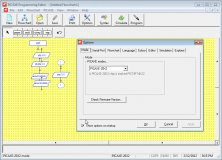


This app allows you to simulate, develope and use programs on the Axe platform








Comments